Wind Chill Calculator
Using this tool you can calculate how cold the body perceives based on the wind’s velocity and the ambient air temperature. It is valid for temperatures ranging from -50 °F up to 50 °F.

What is wind chill?
During the colder months the perceived temperature is normally colder than the measured air temperature, much like how high humidity in summer makes us feel hotter than the thermometer reading. See the Heat Index Calculator for more information.
Heat leaves the skin through three mechanisms: conduction, convection and radiation. While all three play a role, wind‑chill is driven chiefly by convection – the transfer of heat caused by the bulk movement of air molecules. When wind passes over the body it sweeps away the thin layer of warm air that normally cushions the skin, replacing it with cooler air. The stronger the wind, the quicker this exchange and the faster the surface loses heat. In response, the body must generate additional heat to keep its skin temperature stable, which is why we sense a colder temperature when the wind picks up.
How to calculate wind chill
Because wind‑chill is not a precise science, many meteorological agencies have devised their own formulas to estimate the apparent temperature under wind. This calculator adopts the equation formulated by the United States National Weather Service, which is displayed below.
Wind Chill Temperature = 35.74 + 0.6215×T - 35.75×V0.16 + 0.4275×T×V0.16
- where T is the actual air temperature in Fahrenheit, V is the wind speed in mph.
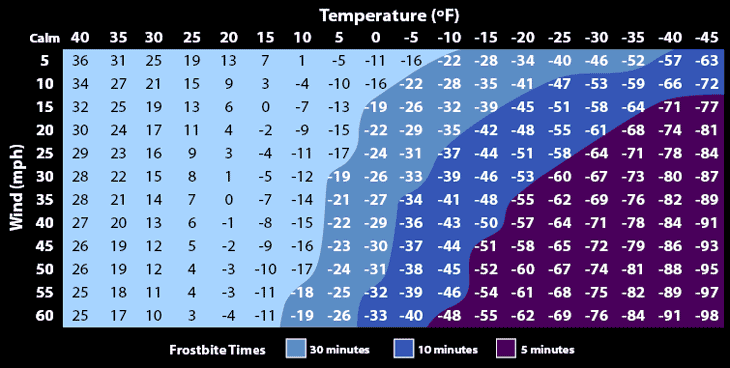
Frostbite
Frostbite occurs when skin or other tissues are exposed to freezing temperatures. Early signs typically include a loss of feeling, a pale or bluish discoloration, and an icy sensation, most often in the fingers, toes, ears or nose. Severe cases can progress to systemic hypothermia (discussed later) or compartment syndrome, a condition in which blood flow to a confined tissue space becomes inadequate.
The speed at which frostbite develops depends on how low the temperature is and how long the exposure lasts. People who spend extended periods in the cold—such as winter athletes, outdoor laborers, or individuals without shelter—are at the greatest risk.
Signs and symptoms:
Frostbite has historically been described in terms of degrees of frostbite, similar to that of burns:
First-degree frostbite:
- Superficial damage that usually isn't permanent
- Numbness/loss of sensation in the skin with possible swelling
- Skin may slough off in the coming weeks
Second-degree frostbite:
- Blisters form and the surface of the skin hardens
- Blistered skin dries, blackens, and peels in the coming weeks
- Possible permanent cold sensitivity and numbness
Third-degree frostbite:
- Tissue below the skin freezes
- Blisters and bluish discoloration of the skin occur
- Blackened crust develops while pain persists in the coming weeks
- Long term damage to growth plates and ulceration can occur
Fourth-degree frostbite:
- Tendon, bone, and muscle are affected
- Hard skin texture and a colorless appearance result, and re-warming occurs without pain
- Skin later becomes black and mummified and the extent of permanent damage may not be known for up to a month
Prevention:
Taking the right precautions can greatly reduce the chance of frostbite when you find yourself in frigid conditions. Key steps include:
- Covering the skin and scalp, avoiding constrictive footwear and clothing, and remaining active
- Avoiding temperatures below -15°C
- Avoiding alcohol and drugs
- Layering clothing
- Using warming devices
- Being aware of early signs of frostnip (similar to frostbite but does not involve ice crystal formation in the skin)
Hypothermia
Hypothermia sets in when the body loses heat faster than it can produce it, causing core temperature to drop below 95.0 °F (35.0 °C). Symptoms range from mild shivering to life‑threatening cardiac arrest.
Extreme cold exposure is the most common trigger for hypothermia, but it can also arise from factors such as alcohol intoxication, low blood sugar, eating disorders, or advanced age.
Mild hypothermia:
- Physiological responses to preserve body heat
- Shivering
- Increased heart rate and respiratory rate
- Increased blood pressure
- Increased urine production
- Mental confusion
Moderate hypothermia:
- Further mental confusion
- Amnesia
- Slurred speech
- Loss of fine motor skills and decreased reflexes
Severe hypothermia:
- Physiological systems start to fail, resulting in decreased heart rate, respiratory rate, and blood pressure.
- Paradoxical undressing — a bewildering behavior where individuals suffering moderate to severe hypothermia remove clothing, often leading to 25‑50 % of hypothermia‑related fatalities.
- Terminal burrowing—behavior that occurs in the final stages of hypothermia where the person suffering from hypothermia enters small, enclosed spaces.
Dress Warmly for Winter
Both frostbite and hypothermia are triggered by extreme cold and may cause lasting, sometimes fatal, health issues. Therefore, wearing suitable clothing and being aware of the dangers of prolonged cold exposure is essential. The following tips outline how to keep warm and protect yourself across different cold ranges. When temperatures drop below certain thresholds, outdoor activity should be avoided entirely because of the severe health hazards.
32 to 15°F (0 to -10°C): Dress warmly, with the outside temperature in mind.
15 °F to –15 °F (–10 °C to –25 °C): Prolonged exposure without proper gear can lead to hypothermia. Opt for a layered outfit: start with a thin, moisture‑wicking base to keep sweat off the skin, add a thicker insulating layer such as fleece, polyester or wool, and finish with a wind‑proof, preferably waterproof outer shell. Include a hat, mittens and a scarf for added protection.
–15 °F to –50 °F (–25 °C to –45 °C): Exposed skin faces frostbite risk, and insufficient protection can cause hypothermia. Dress similarly to the previous range: a light wicking base, a fleece or similar insulating layer, and a wind‑ and water‑resistant outer coat. Ensure all skin, especially the face and hands, is covered. Add extra layers like a synthetic or down jacket if extra warmth is needed.
–50 °F to –75 °F (–45 °C to –60 °C): Skin left uncovered can freeze within minutes, potentially causing permanent damage, and the danger of hypothermia rises sharply the longer you stay outside. Use multiple warm layers as described for milder cold, but incorporate additional heavy insulation and a wind‑ and water‑proof outer shell. Protect every part of the body, particularly the face and hands, and keep outdoor exposure brief—or better yet, cancel it.
–75 °F (–60 °C) and colder: Conditions become extremely hazardous; uncovered skin may freeze in under two minutes. The safest choice is to remain indoors.