Time Zone Calculator
Our Time Zone Calculator lets you switch between any world time zones. For a quick lookup of regional zones, consult this page as a reference.

What is Time Zone
The term "time zone" denotes an area on Earth where the same standard time is observed, often aligned with national borders or meridians. Greenwich Mean Time (GMT) represents the solar time at the Royal Observatory in Greenwich, London, situated at 0° longitude. While GMT and Coordinated Universal Time (UTC) essentially show the same clock reading, GMT functions as a time zone, whereas UTC is a time standard that underpins civil time worldwide. Historically, GMT served as the reference standard, but today it primarily labels the zone used by several African and Western European nations. UTC, derived from ultra‑precise atomic clocks and Earth’s rotation, is the modern global benchmark.
UTC is not dependent on daylight saving time (DST), though some countries switch between time zones during their DST period, such as the United Kingdom using British Summer Time in the summer months.
On land, most zones are expressed as an offset from UTC. UTC divides the day into 24 hours, each hour into 60 minutes, etc., following the Gregorian calendar. Typically a zone is defined as a whole‑hour shift relative to UTC—examples include UTC‑05:00 or UTC+08:00. Offsets span from UTC‑12:00 up to UTC+14:00. While many regions sit exactly an hour away, some use half‑hour or even 45‑minute differences, such as UTC+06:30 or UTC+12:45.
World Time Zone Map
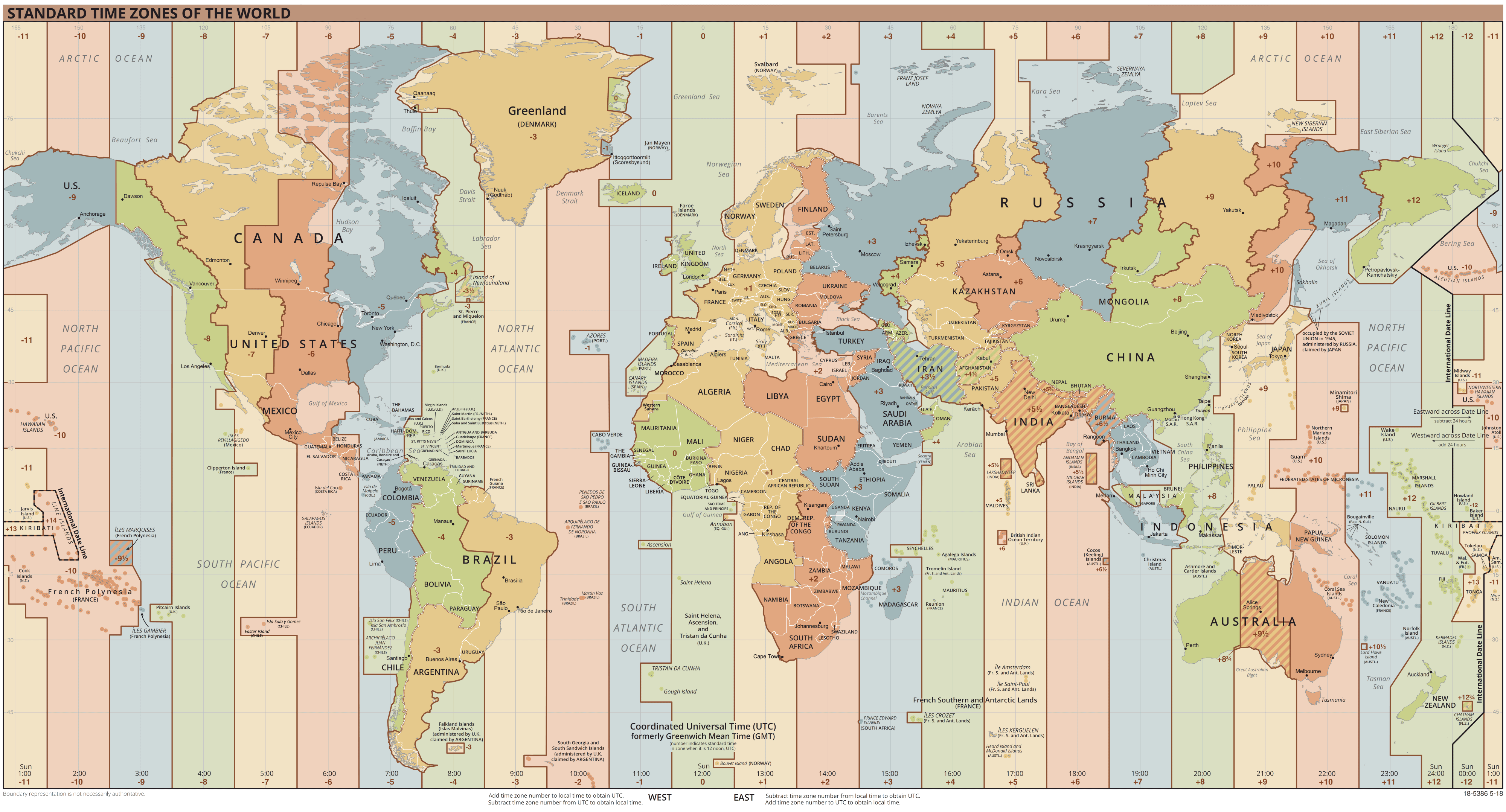
Time‑zone boundaries have shifted over the decades. Most nations settled on hour‑based zones after 1929. Nepal, the last holdout, only aligned with a standard offset in 1956, choosing the uncommon UTC+5:45.
In theory, every 15° of longitude corresponds to a one‑hour change, but the practice varies. China and India each maintain a single national time despite spanning far more than 15° of longitude. Russia, by contrast, is split into 11 zones, though at one stage it was reduced to nine. Thus, while a global guideline exists, the actual division depends heavily on each country’s choices and can evolve.
Below is a world map showing the conventional time zones. Click the image to view it in a larger format.
U.S. Time Zone Map
Several nations span more than one zone. As a rule of thumb, a 15° longitudinal shift usually translates to a one‑hour time difference.
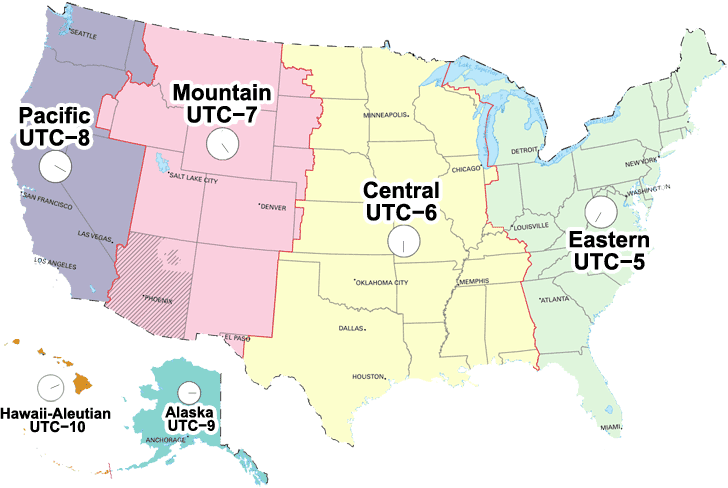
The United States operates nine distinct time zones. The most familiar are Eastern, Central, Mountain, and Pacific, which cover the contiguous states.
- Eastern Time Zone (ET): UTC-05:00 – includes 22 states in the eastern part of the contiguous United States, including some parts of Canada, Mexico, Panama, and the Caribbean islands.
- Central Time Zone (CT) – UTC‑06:00: covers portions of Canada, the United States, Mexico, Central America, some Caribbean islands, and parts of the Eastern Pacific. Only nine states lie entirely within this zone; eleven more share borders with either Mountain or Eastern zones.
- Mountain Time Zone (MT): UTC-07:00 – includes parts of Canada, Mexico, and the U.S. 5 states are fully within the MT zone; ten are shared with either the Pacific Time Zone or the Central Time Zone.
- Pacific Time Zone (PT) – UTC‑08:00: includes sections of Canada, the western United States, and western Mexico. California and Washington fall completely inside PT. Three states are split between PT and Mountain Time, while Alaska is divided between PT and Alaska Time.
Atlantic, Alaska, Hawaii-Aleutian, Samoa, and Chamorro Time Zones cover the rest of the United States, including Alaska, Hawaii, and the other U.S. territories.
All of these time zones have standard time zones that are offset from UTC, from UTC-04:00 through UTC+10:00, though some additionally observe daylight saving time (DST). During DST, the regions that observe DST are offset one hour closer to UTC. The regions that don't observe DST include those in the Atlantic, Samoa, and Chamorro Time Zones.
Daylight Saving Time
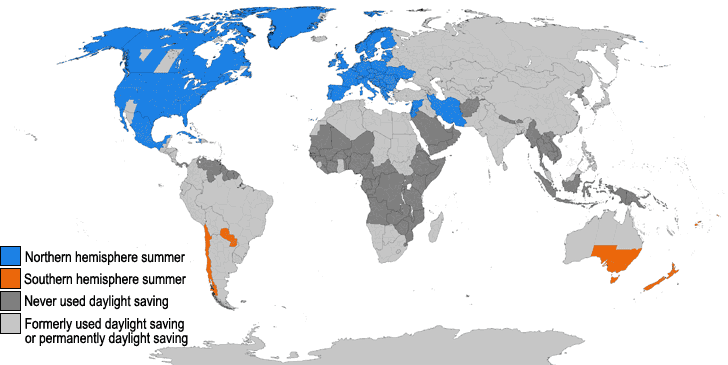
Across much of the world—particularly in Europe and North America—daylight saving time (DST), also known as summer time, is observed to conserve energy. In practice, clocks are set forward one hour at the start of spring and turned back again in the fall. Adjusting the clock this way helps align typical work schedules with the shifting patterns of daylight in many regions. The adjustment has little effect in mountainous zones, where sunrise and sunset occur at times quite different from the standard workday, and in equatorial locales, where day length barely changes over the year.
* This Time Zone Calculator does not consider Daylight Saving Time in its calculations.