Roofing Calculator
These calculators determine a roof's surface size and the quantity of supplies required to build a roof of that size. The "House Base Area" refers to the footprint of the dwelling, and for irregular footprints you can compute it with the Area Calculator.

Roofing Area Calculator
 |
Roofing Material Calculator
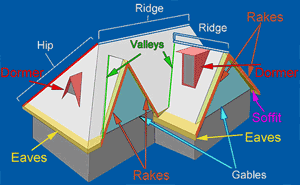
The resulting figure is only an approximation. When a roof has an irregular outline, like the illustration on the right, measuring each segment's dimensions and summing their areas yields a more precise total. The tool cannot handle irregular forms based solely on square‑footage input. The Area Calculator lets you calculate the area of several basic shapes, which together can represent the roof's footprint. Adding the areas of these simple figures gives a closer estimate to use with the Roofing Material Calculator.
In the U.S., the most prevalent roofing options are shingles, membrane systems, and ceramic tiles, each with distinct lifespans. Shingles typically last 15–30 years, membranes about 5–15 years, while ceramic tiles, though costly, can endure over a century.
Roof Pitch
Roof pitch describes the vertical rise of a roof compared to its horizontal run. Though similar to slope, they differ. In the United States we use a 12‑inch (1‑foot) run as the standard, so a 7/12 pitch means the roof climbs 7 inches for every 12 inches horizontally. Outside the U.S., pitch is usually expressed as a degree angle.
The pitch of a roof influences both its cost and its surface area, as well as the choice of materials. It also affects how easily one can walk on it and how water drains; regions with heavy rain or snowfall generally favor steeper pitches.

Roof pitch alters the actual surface area. If the roof area is measured horizontally—perhaps from a plan or photo—a correction factor must be applied to obtain the true area. Multiply the horizontal measurement by the factor that corresponds to the pitch (see the table below) to get the actual area for the Roofing Material Calculator. While a simple total area can give a rough material estimate, the real roof area can vary up to a factor of 2.236 at a 24/12 pitch. Therefore, though more labor‑intensive, measuring each roof segment and applying the appropriate correction factor yields the most accurate material calculation.
Typical Slope Correction Factors:
| Pitch | Angle | Multiply By | Pitch | Angle | Multiply By | |
| 1/12 | 4.8° | 1.003 | 2/12 | 9.5° | 1.014 | |
| 3/12 | 14.0° | 1.031 | 4/12 | 18.4° | 1.054 | |
| 5/12 | 22.6° | 1.083 | 6/12 | 26.6° | 1.118 | |
| 7/12 | 30.3° | 1.158 | 8/12 | 33.7° | 1.202 | |
| 9/12 | 36.9° | 1.250 | 10/12 | 39.8° | 1.302 | |
| 11/12 | 42.5° | 1.357 | 12/12 | 45.0° | 1.414 | |
| 13/12 | 47.3° | 1.474 | 14/12 | 49.4° | 1.537 | |
| 15/12 | 51.3° | 1.601 | 16/12 | 53.1° | 1.667 | |
| 17/12 | 54.8° | 1.734 | 18/12 | 56.3° | 1.803 | |
| 19/12 | 57.7° | 1.873 | 20/12 | 59.0° | 1.944 | |
| 21/12 | 60.3° | 2.016 | 22/12 | 61.4° | 2.088 | |
| 23/12 | 62.4° | 2.162 | 24/12 | 63.4° | 2.236 |