Circle Calculator
Please provide any value below to calculate the remaining values of a circle.
A circle, geometrically, is a simple closed shape. More specifically, it is a set of all points in a plane that are equidistant from a given point, called the center. It can also be defined as a curve traced by a point where the distance from a given point remains constant as the point moves.
Parts of a circle
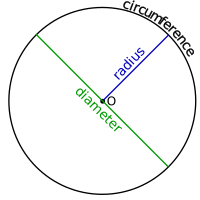
- Center (or origin): the point within a circle that is equidistant from all other points on the circle.
- Radius: the distance between any point on the circle and the center of the circle. It is equal to half the length of the diameter.
- Diameter: the largest distance between any two points on a circle; by this definition, the diameter of the circle will always pass through the center of the circle. It is equal to twice the length of the radius.
- Circumference: the distance around the circle, or the length of a circuit along the circle.
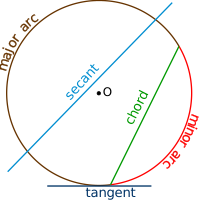
- Arc: part of the circumference of a circle
- Major arc: an arc that is greater than half the circumference
- Minor arc: an arc that is less than half the circumference
- Chord: a line segment from one point of a circle to another point. A chord that passes through the center of the circle is a diameter of the circle.
- Secant: a line that passes through the circle at two points; it is an extension of a chord that begins and ends outside of the circle.
- Tangent: a line that intersects the circle at only a single point; the rest of the line, except the single point at which it intersects the circle, lies outside of the circle.
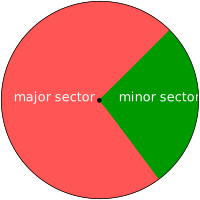
- Sector: the area of a circle created between two radii.
- Major sector – a sector with a central angle larger than 180°
- Minor sector – a sector with a central angle less than 180°
The figures below depict the various parts of a circle:
The constant π
The radius, diameter, and circumference of a circle are all related through the mathematical constant π, or pi, which is the ratio of a circle's circumference to its diameter. The value of π is approximately 3.14159. π is an irrational number meaning that it cannot be expressed exactly as a fraction (though it is often approximated as  ) and its decimal representation never ends or has a permanent repeating pattern. It is also a transcendental number, meaning that it is not the root of any non-zero polynomial that has rational coefficients.
In the past, ancient geometers dedicated a significant amount of time in an effort to "square the circle." This was a process that involved attempting to construct a square with the same area as a given circle within a finite number of steps while only using a compass and straightedge. While it is now known that this is impossible, it was not until 1880 that Ferdinand von Lindemann presented a proof that π is transcendental, which put an end to all efforts to "square the circle." While the efforts of ancient geometers to accomplish something that is now known as impossible may now seem comical or futile, it is thanks to people like these that so many mathematical concepts are well defined today.
Circle formulas
|
D = 2R
C = 2πR
A = πR2
|
where:
R: Radius
D: Diameter C: Circumference A: Area π: 3.14159 |