Triangle Calculator
Enter any three measurements, making sure at least one of them is a side length, into the six input fields and press the "Calculate" button. If you choose radians for the angle unit, you may type values like π/2, π/4, etc.
A triangle is a three‑sided polygon whose corners are called vertices. Each vertex is the meeting point of two line segments; together the three vertices are linked by three edges. We usually label a triangle by its vertices, for instance Δabc denotes the triangle with corners a, b and c. Triangles are commonly classified by side lengths: when all three sides match we have an equilateral triangle, if exactly two are equal it is isosceles, and when no sides are the same it is called scalene.
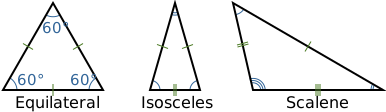
Small tick marks drawn on a side are a typical way to indicate its length—identical numbers of ticks mean equal lengths. Likewise, interior angles are shown by different counts of concentric arcs at the vertices. Because side lengths and interior angles are linked, an equilateral triangle naturally possesses three equal angles as well as three equal sides. Keep in mind that the graphic shown in the calculator is not drawn to scale; although it may look equilateral and carries equal‑angle marks, the actual dimensions depend on the numbers you input, and the result will display the correct shape.
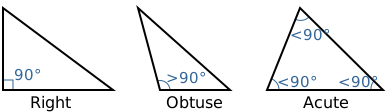
Triangles can be grouped according to their interior angles into right and oblique types. A right‑angled triangle contains one 90° angle, which is usually highlighted by a small square at the vertex. The side opposite this right angle, and the longest side of the triangle, is called the hypotenuse. All other triangles are termed oblique; they are either acute, with every angle smaller than 90°, or obtuse, where one angle exceeds 90°, as illustrated below.
Triangle facts, theorems, and laws
- It is not possible for a triangle to have more than one vertex with internal angle greater than or equal to 90°, or it would no longer be a triangle.
- The interior angles of a triangle always add up to 180° while the exterior angles of a triangle are equal to the sum of the two interior angles that are not adjacent to it. Another way to calculate the exterior angle of a triangle is to subtract the angle of the vertex of interest from 180°.
- The sum of the lengths of any two sides of a triangle is always larger than the length of the third side
-
- Law of sines: For any triangle, the ratio of a side’s length to the sine of the angle opposite it remains constant. This relationship lets you determine unknown sides or angles when enough data are supplied. Using the notation shown in the calculator (sides a, b, c and opposite angles A, B, C), the law can be expressed as b/sin(B) = c/sin(C). If b, B and C are known, you can solve for c by equating b / sin B with c / sin C. Be aware that under certain conditions a single set of measurements can correspond to two distinct triangle shapes (the ambiguous case).
Given b=2, B=90°, C=45°, find c:
- When the lengths of all three sides (a, b, c) are known, each interior angle can be found with the following expression. See the triangle above for reference.
| A = arccos( |
|
) |
| B = arccos( |
|
) |
| C = arccos( |
|
) |
Given a=8, b=6, c=10, find B:
| B = | arccos( |
|
) |
| = | arccos(0.8) = 36.87° |
Area of a Triangle
Various formulas exist for computing a triangle’s area, depending on which measurements are available. The most familiar one uses the base b and the corresponding height h. Here “base” may be any side, and the height is the perpendicular distance from the opposite vertex to that side.
| EX: | 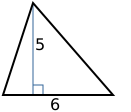 |
If you know the lengths of two sides and the angle formed between them, the area can be obtained with this formula. The variables refer to the triangle displayed in the calculator. For example, with a = 9, b = 7 and the included angle C = 30°:
| area = |
|
ab × sin(C) |
| = |
|
bc × sin(A) |
| = |
|
ac × sin(B) |
| EX: area = |
|
× 7 × 9 × sin(30°) |
| = |
15.75 |
Heron’s formula provides another way to compute a triangle’s area without selecting a base or a reference vertex. It requires only the three side lengths. Referring again to the calculator’s triangle, suppose a = 3, b = 4 and c = 5:
| area = | √s(s - a)(s - b)(s - c) |
|
|
|
|
| area = | √6(6 - 3)(6 - 4)(6 - 5) = 6 |
Median, inradius, and circumradius
Median
In a triangle, a median is the segment that joins one vertex with the midpoint of the opposite side. Every triangle possesses three such medians, and they all meet at a single point called the centroid – the geometric center representing the average position of all points of the triangle. See the illustration below for a visual aid.
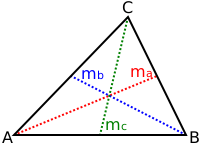
The medians of the triangle are represented by the line segments ma, mb, and mc. The length of each median can be calculated as follows:
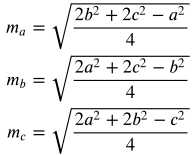
Where a, b, and c represent the length of the side of the triangle as shown in the figure above.
As an example, given that a=2, b=3, and c=4, the median ma can be calculated as follows:

Inradius
The inradius is the radius of the largest circle that can be inscribed inside a polygon, here a triangle. This circle touches each side at a right angle. To determine the inradius of a triangle, draw the two angle bisectors to locate the incenter; the perpendicular distance from this incenter to any side equals the inradius, because the incenter is equidistant from all three sides.
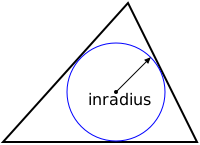
For the purposes of this calculator, the inradius is calculated using the area (Area) and semiperimeter (s) of the triangle along with the following formulas:
where a, b, and c are the sides of the triangle
Circumradius
The circumradius is the radius of the circumcircle – the circle that passes through all three vertices of a triangle. Its center, the circumcenter, is found at the intersection of the perpendicular bisectors of the triangle’s sides. The circumcenter may lie inside or outside the triangle, but every triangle has a circumcircle and therefore a circumradius.
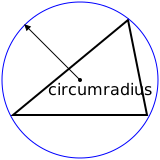
For the purposes of this calculator, the circumradius is calculated using the following formula:
Where a is a side of the triangle, and A is the angle opposite of side a
Although side a and angle A are being used, any of the sides and their respective opposite angles can be used in the formula.
