Body Type Calculator
Our Body Shape Calculator helps women identify their silhouette, offering personalized fashion suggestions. While some studies associate specific silhouettes with health concerns, the shape classification provided here isn’t meant as a medical assessment or a standard to achieve. For health insights, the waist‑to‑hip ratio displayed alongside the results is a more reliable metric.


Take measurements while standing upright with your arms relaxed at your sides. The tape should fit close to the skin without digging in, as excessive pressure can distort the reading.
Bust size—the circumference measured around the chest over the fullest part of the breasts, while wearing a properly fitted bra.
Waist size—the smallest circumference measured around the natural waist, just above the belly button.
Upper hip circumference – the girth measured at the fullest part of the hips, just above the pelvis. This line is typically located about 7 inches (18 cm) beneath the natural waist.
Hip size—the largest circumference measured around the hips over the largest part of the buttocks.
Female body shapes in the fashion industry
In the fashion industry, body shapes are often categorized into four classes.
Apple, or inverted triangle
This body shape describes a person who has broader shoulders and bust than they do hips.
Banana, straight, or rectangle
This body shape describes a person who typically has waist measurements that are less than 9 inches smaller than the hip or bust measurements.
Pear, spoon, bell, or triangle
This body shape describes a person who has hip measurements greater than their bust measurements.
Hourglass, X shape, triangles opposing, or facing inwards
This body shape (typically presented as the "ideal") describes a person with hip and bust measurements nearly equal in size, with a narrower waist measurement.
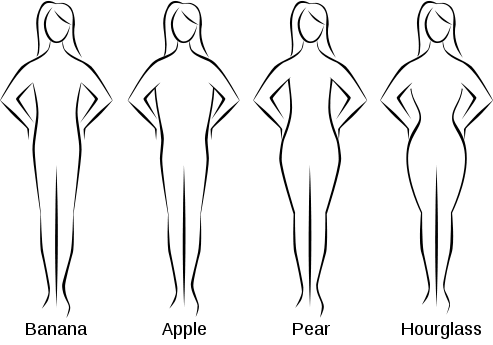
A study of more than 6,000 women conducted at North Carolina State University in 2005 revealed that 46% of women were banana-shaped; just over 20% were pear-shaped; just under 14% were apple-shaped; and only 8% were hourglass-shaped.
What is my body shape?
The classifications of women's silhouettes reflect cultural ideals that vary across societies. The algorithm behind this tool follows a research article from the International Journal of Clothing Science and Technology, which identifies seven principal female body types1. Within each category there is a broad spectrum of actual measurements, and some individuals may not match any of the listed shapes.
Hourglass
If (bust - hips) ≤ 1" AND (hips - bust) < 3.6" AND (bust - waist) ≥ 9" OR (hips - waist) ≥ 10"
Bottom hourglass
If (hips - bust) ≥ 3.6" AND (hips - bust) < 10" AND (hips - waist) ≥ 9" AND (high hip/waist) < 1.193
Top hourglass
If (bust - hips) > 1" AND (bust - hips) < 10" AND (bust - waist) ≥ 9"
Spoon
If (hips - bust) > 2" AND (hips - waist) ≥ 7" AND (high hip/waist) ≥ 1.193
Triangle
If (hips - bust) ≥ 3.6" AND (hips - waist) < 9"
Inverted triangle
If (bust - hips) ≥ 3.6" AND (bust - waist) < 9"
Rectangle
If (hips - bust) < 3.6" AND (bust - hips) < 3.6" AND (bust - waist) < 9" AND (hips - waist) < 10"
Waist-hip ratio
Waist‑to‑hip ratio (WHR) compares the circumference of the waist with that of the hips. It is obtained by dividing the waist measurement by the hip measurement. For instance, a 34‑inch waist and a 40‑inch hip yield a WHR of 34/40 = 0.85. WHR is sometimes used to gauge health risks: research indicates that people carrying more weight around the waist (often termed “apple‑shaped”) face higher chances of illness than those with greater hip fat (“pear‑shaped”). According to the National Institute of Diabetes, Digestive and Kidney Diseases (NIDDK), women with WHR > 0.8 and men with WHR > 1.0 experience elevated health risks linked to fat distribution.
WHR also serves as a proxy for obesity. The World Health Organization (WHO) classifies men with a WHR exceeding 0.90 and women with a WHR over 0.85 as obese, which roughly aligns with a body‑mass index above 30. Obesity is associated with serious conditions such as high blood pressure, coronary disease, diabetes, certain cancers, and more. In older adults, WHR has been shown to predict mortality better than waist circumference or BMI, and it also outperforms those measures in forecasting cardiovascular disease. A study by Yusuf S. et al.2 suggests that redefining obesity based on WHR rather than BMI could triple the number of people identified as at risk for heart attacks.
Visceral fat, typical of “apple‑shaped” bodies, is linked to greater health hazards than subcutaneous fat stored in the limbs. A higher WHR signals more abdominal fat, and the risk of health complications rises accordingly. For details on various fat types and the implications of excess weight, consult the Body Fat Calculator.
WHR is also tied to reproductive health, with optimal values differing by gender. Women whose WHR exceeds 0.80 tend to have noticeably lower conception rates than those whose ratios fall between 0.70 and 0.79. Conversely, men with WHR around 0.9 generally show higher fertility, better overall health, and a reduced likelihood of prostate and testicular cancers.
Aside from the associated health risks, WHR has also been studied in relation to cognitive ability, as a measure of female attractiveness, and even in relation to food composition in a diet.
- Lee, J.Y., Istook,C.L., Nam, Y. J., and Park, S. M.,, "Comparison of body shape between USA and Korean women", International Journal of Clothing Science and Technology, Vol.19, No.5, 2007, pp.374-391.
- Yusuf S, Hawken S, Ounpuu S, Bautista L, Franzosi MG, Commerford P, Lang CC, Rumboldt Z, Onen CL, Lisheng L, Tanomsup S, Wangai P, Razak F, Sharma AM, Anand SS (November 2005). "Obesity and the risk of myocardial infarction in 27,000 participants from 52 countries: a case-control study". Lancet. 366 (9497): 1640-9.