Interest Calculator
Our compound‑interest tool lets you see how both a one‑time principal and regular deposits grow over time, including the effect of taxes on the earned interest and inflation if you wish.

Accumulation Schedule
| Year | Deposit | Interest | Ending balance |
|---|---|---|---|
| 1 | $25,000.00 | $1,250.00 | $26,250.00 |
| 2 | $5,000.00 | $1,562.50 | $32,812.50 |
| 3 | $5,000.00 | $1,890.63 | $39,703.13 |
| 4 | $5,000.00 | $2,235.16 | $46,938.28 |
| 5 | $5,000.00 | $2,596.91 | $54,535.20 |
Interest is what borrowers pay lenders for using their money, expressed either as a percentage or a fixed sum, and it underpins virtually every financial product you encounter.
There are two distinct methods of accumulating interest, categorized into simple interest or compound interest.
Simple Interest
Consider a simple scenario: Derek wants a $100 loan for a year, and the bank charges a 10 % rate. Here's how you would work out the interest owed.
$100 × 10% = $10
This interest is added to the principal, and the sum becomes Derek's required repayment to the bank one year later.
$100 + $10 = $110
Derek owes the bank $110 a year later, $100 for the principal and $10 as interest.
Now imagine Derek extends the loan to two years, with the bank applying the rate once per year. He will pay the 10 % charge at the close of each year.
$100 + $10(year 1) + $10(year 2) = $120
Derek owes the bank $120 two years later, $100 for the principal and $20 as interest.
The formula to calculate simple interest is:
interest = principal × interest rate × term
When more complicated frequencies of applying interest are involved, such as monthly or daily, use the formula:
| interest = principal × interest rate × |
|
In practice, simple interest is rare; most of the time when people speak of ‘interest’ they actually mean interest that compounds.
Compound Interest
Because compounding needs multiple periods, return to Derek’s two‑year loan at 10 %: we compute the first year’s interest just like before.
$100 × 10% = $10
This interest is added to the principal, and the sum becomes Derek's required repayment to the bank for that present time.
$100 + $10 = $110
When the first year finishes, the next period begins. With compounding, the new base is the original principal plus the interest already earned. So Derek now has $110 as the starting point for year two.
$110 × 10% = $11
Derek's interest charge at the end of year 2 is $11. This is added to what is owed after year 1:
$110 + $11 = $121
At the end of the term the bank receives $121, not $120 as a simple‑interest calculation would give, because interest has been earned on the previously accrued interest.
The shorter the compounding interval, the more the original sum grows. Below is a chart that illustrates a $1,000 investment earning 20 % with different compounding frequencies.
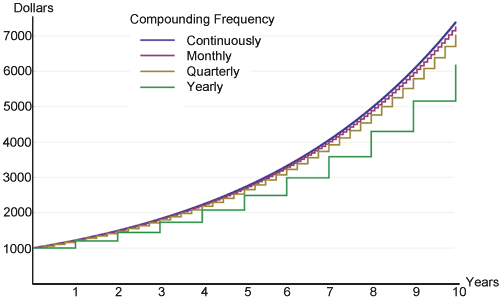
Initially the curves are close together, but as time passes they separate, highlighting the advantage of frequent compounding. The continuous‑compounding line stays on top, reflecting the theoretical maximum return.
The Rule of 72
If you want a quick mental shortcut for estimating how long it takes for an investment to double, the Rule of 72 is handy. It isn't meant for precise calculator‑level results, but gives a rough ballpark. Divide 72 by the annual interest rate to approximate the number of years needed to double the principal.
Example: How long would it take to double $1,000 with an 8% interest rate?
| n = |
|
= 9 |
At an 8 % yearly rate, a thousand dollars would grow to two thousand after roughly nine years. The rule is most reliable for rates between six and ten percent, though it still gives a decent estimate for rates up to about twenty percent.
Fixed vs. Floating Interest Rate
Loans and savings can carry either a fixed rate or a variable (floating) one. Variable rates usually track a benchmark such as the Federal Reserve’s funds rate or the London Interbank Offered Rate (LIBOR). Typically the borrowing rate sits slightly above the reference, while the deposit rate is a bit below, with the spread feeding the bank’s margin. Both the Fed rate and LIBOR are short‑term inter‑bank rates; the Fed uses its rate to steer U.S. money supply, whereas LIBOR reflects the average borrowing costs among top‑tier banks. Our calculator is designed for fixed‑rate scenarios only.
Contributions
The calculator also supports regular contributions, which is useful for savers who add a fixed amount each period. One key point is whether the deposit is made at the start or at the end of a compounding interval—end‑of‑period deposits miss out on one interest cycle compared with start‑of‑period ones.
Tax Rate
Interest earnings from many sources—such as bonds, savings accounts, or certificates of deposit—are generally taxable. In the United States, corporate bond interest is almost always subject to tax. Some instruments are fully taxed, others only partially; for instance, interest on U.S. Treasury securities is taxable at the federal level but usually exempt from state and local taxes. Taxes can dramatically shrink the final amount. For illustration, if Derek invests $100 at a 6 % rate for 20 years, his pre‑tax balance would be:
$100 × (1 + 6%)20 = $320.71
That figure assumes no taxes. With a 25 % marginal tax rate applied each compounding period, Derek’s ending balance drops to about $239.78.
Inflation Rate
When using our Interest Calculator, you can set the inflation input to zero for a quick, simplified projection. To obtain more realistic outcomes, enter an appropriate inflation rate.
When taxes and inflation act together, preserving the real purchasing power of money becomes challenging. In the U.S., a typical middle‑class household faces a marginal tax rate near 25 % and an inflation rate around 3 %. To keep up, one would need a net return of at least 4 % annually, which is not easy to achieve.